Golf basics for beginners
The Beginner's Guide to Golf Clubs and When to Use Them
Know which club to pull for tee shots, approaches, chips, bunkers, and putts without memorizing the whole pro-shop wall.
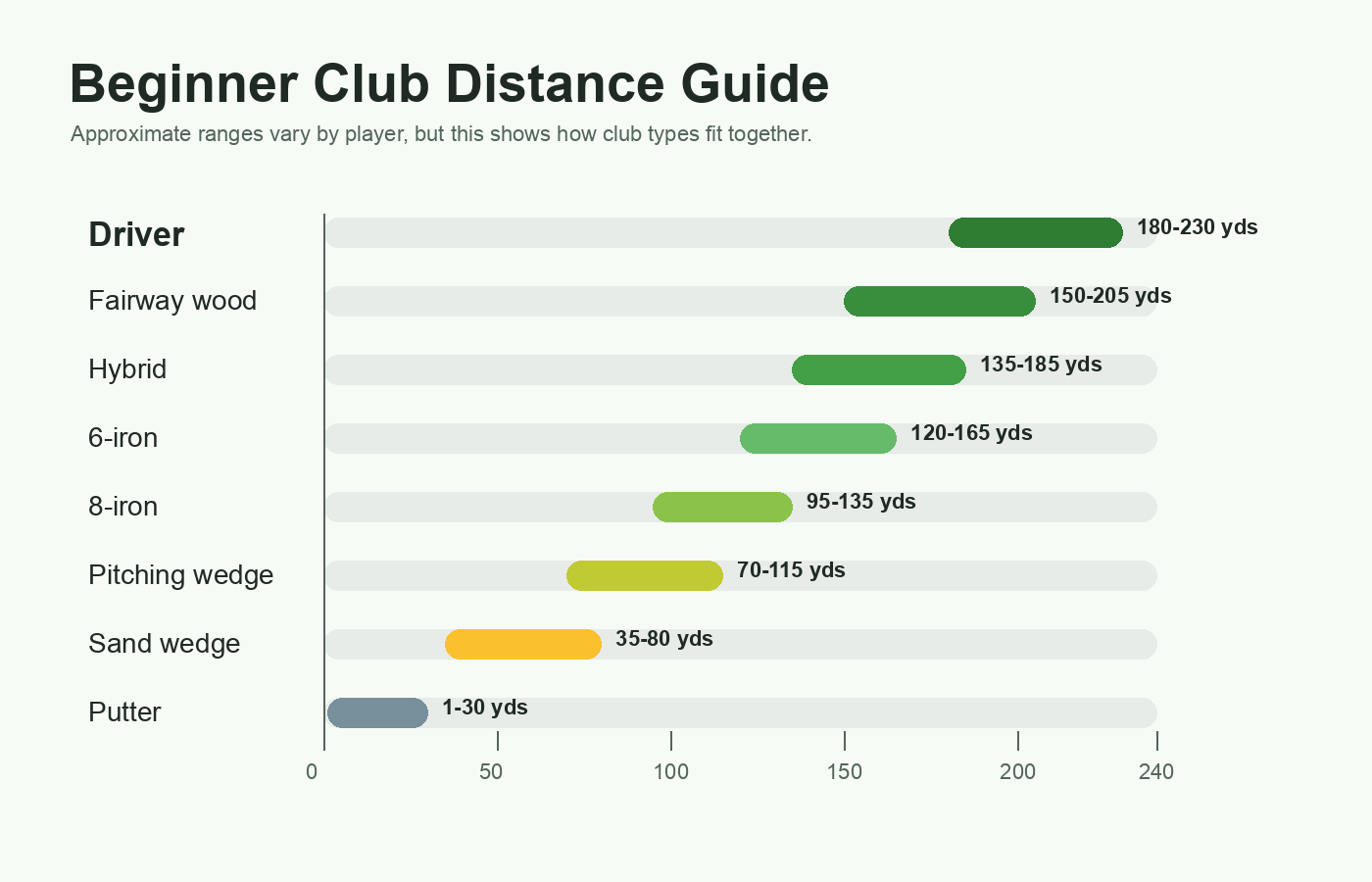
Distance, loft, and forgiveness
Clubs trade distance for control. Lower-lofted clubs fly farther and lower but are harder to launch. Higher-lofted clubs fly shorter, climb faster, and are easier to stop. That’s why a hybrid may be smarter than a driver on a narrow hole, and why a pitching wedge beats a 7-iron when you need height over a bunker.
Driver: big distance, big misses
The driver is built for tee shots on longer par 4s and par 5s. It can be thrilling, but its long shaft and low loft punish off-center contact. If your driver brings trees, out-of-bounds stakes, and lost balls into play, tee off with a hybrid until your swing settles.
Fairway woods and hybrids
Fairway woods can cover long yardages from the tee or short grass. Hybrids are often easier for new golfers because the wider sole helps the club glide through light rough. A 4- or 5-hybrid can become your safest club for advancing the ball 140-180 yards without drama.
Irons for approach shots
Irons are your green-finding clubs. A 6-iron travels farther and lower than a 9-iron; a 9-iron flies higher and lands softer. Beginners usually get the most value from mid- and short irons because they offer enough loft to help the ball airborne.
| Situation | Sensible beginner choice |
|---|---|
| Narrow tee shot | Hybrid or 5-wood |
| 120 yards from fairway | 8-iron or 9-iron |
| Ball in light rough | Hybrid or short iron |
| Short shot over sand | Sand wedge |
| On the green | Putter |
Wedges and putter
Wedges handle the scoring zone: chips, pitches, bunker shots, and short approaches. The putter is used on the green and often just off it when the grass is tight. If you can putt from the fringe instead of trying a delicate chip, do it. Simple beats stylish.